
Jolly Phonics Teacher’s Book: What’s Inside and How to Use It
The Jolly Phonics Teacher’s Book is the lesson guide that goes with Pupil Books 1, 2 and 3. It has 184 pages in the June 2025 edition, with step-by-step lesson plans, an introduction to the method, checklists, the English alphabetic code chart and guidance for struggling readers.
This page breaks down what is inside, who it helps and how to study it. See also the overview of all four Jolly Phonics books.
Table of Contents
- Jolly Phonics Teacher’s Book: Quick Facts
- What Is the Jolly Phonics Teacher’s Book?
- Who Should Use It?
- What’s Inside: Syllabus-Style Breakdown
- How a Teacher’s Book Lesson Runs
- Skills It Builds and How It Benefits Teaching
- How to Study the Teacher’s Book
- Common Mistakes When Using It
- Related Reading
- Frequently Asked Questions
Quick answer
- Jolly Phonics Teacher’s Book: Quick Facts These details are from the publisher’s listing for the June 2025 edition.
- What Is the Jolly Phonics Teacher’s Book? The Jolly Phonics Teacher’s Book is the guide for the adult who is teaching.
- Who Should Use It? If you want to learn to teach the programme with a trainer, see our Level 1 phonics teacher training for ages 4–6.
- What’s Inside: Syllabus-Style Breakdown The publisher lists these parts in the June 2025 edition:
- How a Teacher’s Book Lesson Runs The publisher’s sample lesson for the sound /r/ shows the usual pattern for teaching a new sound from the Teacher’s Book.
Jolly Phonics Teacher’s Book: Quick Facts
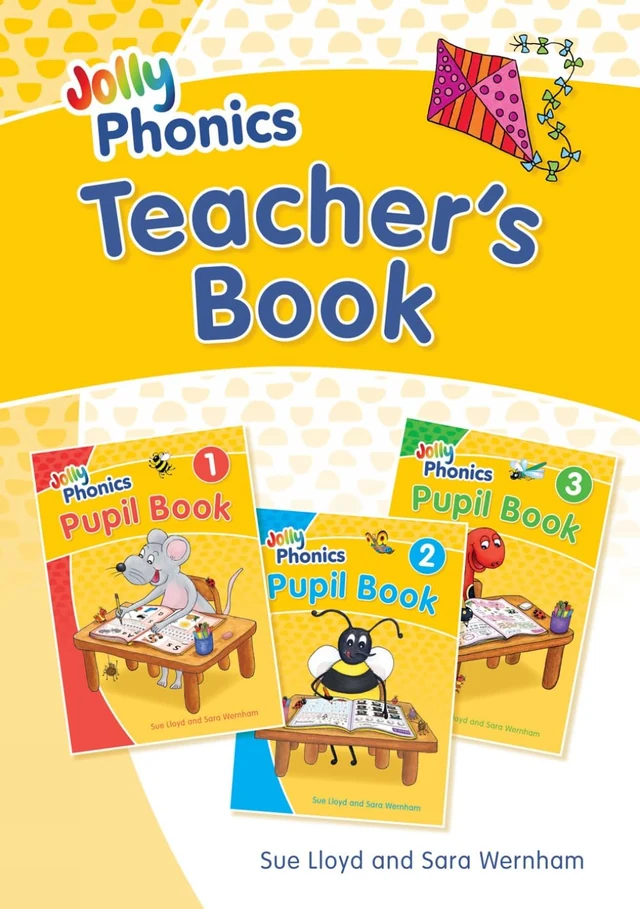
| Authors | Sue Lloyd and Sara Wernham |
|---|---|
| Publisher | Jolly Learning |
| Role | The lesson plans and guidance for Pupil Books 1, 2 and 3 |
| Pages | 184 |
| Edition | Refreshed edition, June 2025. British English, paperback |
| ISBN | 978-1-83582-401-6 (print letters); 978-1-83582-400-9 (precursive letters) |
| Size | 297 × 210 mm |
| Used with | Pupil Books 1, 2 and 3, and The Phonics Handbook |
| Start with it? | Yes, it is the first book to read if an adult is teaching |
These details are from the publisher’s listing for the June 2025 edition. Older editions have a different design and ISBN, and the publisher says the core content is the same.
What Is the Jolly Phonics Teacher’s Book?
The Jolly Phonics Teacher’s Book is the guide for the adult who is teaching. It gives step-by-step lesson plans for each page of Pupil Books 1 to 3, an introduction to the Jolly Phonics method, and the checklists, charts and templates a teacher needs to run lessons consistently.
Think of the Pupil Books as the child’s workbook and the Teacher’s Book as the teacher’s plan. Without it, the Pupil Books still have activities, but the teacher has to guess the order, the wording and the answers.
Who Should Use It?
| If you are… | The Teacher’s Book helps you… |
|---|---|
| A parent teaching at home | Follow a clear lesson order, know what to say, and check the Pupil Book answers |
| A preschool or primary teacher | Plan whole-class lessons and keep the teaching consistent across the year |
| A tutor | Plan short one-to-one or small-group lessons without improvising the method |
| A trainee phonics teacher | Learn the method in one place, with background knowledge for new teachers |
| A homeschooling parent | Follow the sequence on your own and see what comes next |
| A teacher supporting a struggling reader | Use the guidance on teaching struggling readers, then judge whether further support is needed |
If you want to learn to teach the programme with a trainer, see our Level 1 phonics teacher training for ages 4–6.
What’s Inside: Syllabus-Style Breakdown
The publisher lists these parts in the June 2025 edition:
| Part | What it gives you | How it helps |
|---|---|---|
| Step-by-step lesson plans | A plan for each corresponding page of Pupil Books 1 to 3 | Consistent lessons, so each sound or skill is taught in the same clear way |
| Introduction to Jolly Phonics | Background knowledge and methodology for new teachers | Understand why the method works before teaching it |
| Key teaching points and differentiation tips | Short pointers for each lesson, and ideas for children who need more or less support | Keep the whole group moving without leaving anyone behind |
| English alphabetic code chart | A chart of how English sounds are spelled | See the sound-to-spelling pattern at a glance |
| Pupil checklists | Lists to record which sounds and skills each child has | Track progress honestly and plan the next lesson |
| Pink Level materials | New materials for the Pink Level readers | Link the phonics lessons to reading practice |
| Templates, visuals, appendices and case studies | Practical tools to copy or adapt | Save planning time |
| Scope and sequence for Steps 1 to 3 | An updated map of what is taught and in what order | Plan the year and see the whole programme |
| Guidance on teaching struggling readers | Advice for children who find reading hard | Know what to adjust and when to look for more support |
| What to teach after Jolly Phonics | Summaries of the Jolly Literacy programmes for spelling, grammar and punctuation, and for reading comprehension and writing | Plan the next stage after Pupil Book 3 |
| Science of Reading and Writing | An explanation of how Jolly Phonics aligns with it | Explain the method to colleagues and parents |
The 2025 edition also adds a new cover and page design, colour-coding and a revised contents section, clearer answer keys for the Pupil Book activities and clearer links to The Phonics Handbook.
How a Teacher’s Book Lesson Runs
The publisher’s sample lesson for the sound /r/ shows the usual pattern for teaching a new sound from the Teacher’s Book. In order:
- Lesson objective. What the child will learn.
- Flash card revision. A quick revisit of earlier sounds before the new one.
- Storyline. A short story that introduces the sound.
- Action. The action for the sound.
- Letter formation. How to write the letter.
- Blending. Using the sound sheet to blend words with the new sound.
- Sounding. Listening for the sound in different words.
- Sound sheet. The matching Pupil Book page.
- Word bank and dictation. Words to read and write.
- Further ideas. Extra activities.
Each step is short. The pattern is the same for every new sound, so the child always knows what is coming. You can see the same thinking in our Jolly Phonics lesson plan guide.
Skills It Builds and How It Benefits Teaching
| Benefit | What it means in practice |
|---|---|
| Consistency | The same lesson shape for every sound, so children feel secure and teachers do not reinvent the method |
| Confidence for new teachers | Background knowledge, wording and a lesson order are written down |
| Better use of the Pupil Books | The adult knows what each page is for and what the answers should be |
| Clear tracking | Checklists show which sounds a child knows and what to revisit |
| Support for different learners | Differentiation tips and guidance for struggling readers |
| A map of the whole programme | Scope and sequence for Steps 1 to 3 and what to teach after Jolly Phonics |
No book can make teaching effective by itself. The benefit comes from using the plans with clear sounds, regular practice and honest checking of what the child can do.
How to Study the Teacher’s Book
If you are learning to teach, do not read it cover to cover. Study it in this order:
- Read the introduction to the method and the English alphabetic code chart.
- Read the lesson plan for the first sounds, then teach one aloud to a friend or family member.
- Open Pupil Book 1 beside it so you can see how the lesson matches the page.
- Read the guidance on struggling readers, even if you are not teaching one yet.
- Use the checklists with a real child, then plan the next lesson from what you find.
A trainer can shorten this. In Teacher Training Level 1 you learn the method with a trainer and practise it. For older learners, Level 2 covers advanced phonics.
Common Mistakes When Using It
- Skipping the lesson plan and handing the child the Pupil Book alone.
- Moving to the next sound before the child can recognise the current one.
- Saying sounds with an extra “uh”, for example “buh” for /b/.
- Using a different letter style from the child’s school, so handwriting is taught two ways.
- Treating the checklist as a test instead of a planning tool.
- Buying the wrong edition: check that the Teacher’s Book matches the Pupil Books (print or precursive).
Related Reading
Also see the overview of all four books, the 5 skills of Jolly Phonics and how to become a phonics teacher.
Independent study guide. Jolly Phonics books are written by Sue Lloyd and Sara Wernham and published by Jolly Learning. Jolly Reading is an independent teaching and training provider. We do not publish or sell these books, and this page is not an official publisher page. Book details come from the publisher’s catalogue and product listings; check your own copy for the exact edition, page layout and price.
Where the book details come from. Jolly Learning catalogue (2024), Jolly Learning product listings for the Teacher’s Book, and the publisher’s sample lesson for the sound /r/. Teaching advice on this page is ours and is written for study purposes, not as a reproduction of the book.
Frequently Asked Questions
What is the Jolly Phonics Teacher’s Book? +
It is the guide for the adult who is teaching. It has step-by-step lesson plans for Pupil Books 1 to 3, an introduction to the method, checklists, templates and guidance on teaching struggling readers.
Do I need the Teacher’s Book if I already have the Pupil Books? +
Yes, it is strongly recommended. The Pupil Books are the child’s activity pages. The lesson plans and answer keys are in the Teacher’s Book.
How many pages does the Teacher’s Book have? +
The June 2025 edition has 184 pages.
What is new in the 2025 edition? +
The publisher lists a new cover and page design, colour-coding and a revised contents section, clearer answer keys for the Pupil Book activities, new Pink Level materials and clearer links to The Phonics Handbook. The core content is the same as before.
Is the Teacher’s Book suitable for parents? +
Yes. It was written for teachers, but a parent who follows the lesson order can use it at home. Keep sessions short and check each sound before moving on.
Which Teacher’s Book should I buy, print or precursive? +
Buy the one that matches your Pupil Books and your child’s school handwriting style. The content is the same; the letter shapes differ.
Does it help with children who find reading hard? +
It includes guidance on teaching struggling readers. It cannot diagnose a difficulty. If you are concerned, speak to a suitably qualified professional as well.