
Jolly Phonics Pupil Book 3: What’s Inside and How to Use It
Jolly Phonics Pupil Book 3 consolidates the skills from Books 1 and 2. It introduces new alternative spellings and tricky words, with reading comprehension activities and work on words and sentences. It has 48 pages.
This page is a study guide to Book 3, including what it covers, how it benefits a child and what to do after it. It follows Pupil Book 2.
Table of Contents
- Jolly Phonics Pupil Book 3: Quick Facts
- What Is Jolly Phonics Pupil Book 3?
- Who It Is For and When to Start
- Syllabus: The Three Topics
- Alternatives in Pupil Book 3
- Reading Comprehension: What It Means at This Stage
- Skills It Builds and How It Benefits Your Child
- How to Use Pupil Book 3, Step by Step
- Common Mistakes
- What Comes After Pupil Book 3?
- Related Reading
- Frequently Asked Questions
Quick answer
- What Is Jolly Phonics Pupil Book 3? Jolly Phonics Pupil Book 3 builds and consolidates the reading and writing skills from Books 1 and 2.
- Who It Is For and When to Start The age range (3–6 years) is the same as Book 1 in the publisher listing, because the books are meant to be used in sequence over time.
- Syllabus: The Three Topics As with Book 2, the exact page order is in the book and in the Teacher’s Book .
- Alternatives in Pupil Book 3 Book 3 adds new alternative spellings to those in Book 2.
- Reading Comprehension: What It Means at This Stage Comprehension means understanding what has been read.
Jolly Phonics Pupil Book 3: Quick Facts
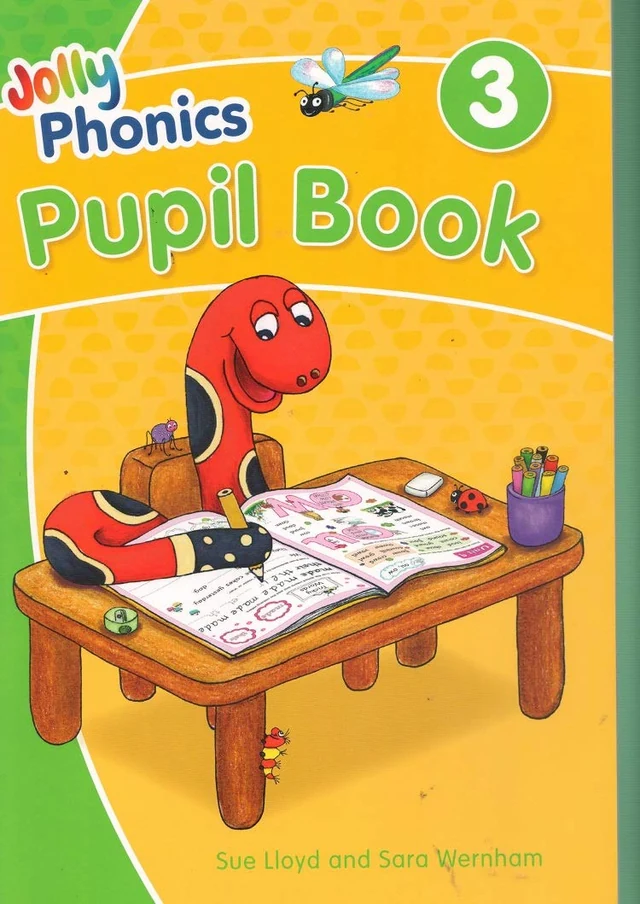
| Authors | Sara Wernham and Sue Lloyd |
|---|---|
| Publisher | Jolly Learning |
| Role | The third write-in book; builds and consolidates Books 1 and 2 |
| Pages | 48 |
| Three main topics | Alternatives, Tricky Words, Words and Sentences |
| Edition | Colour, British English; refreshed edition with the same core content (2020) |
| ISBN | 978-1-84414-721-2 (print letters); 978-1-84414-718-2 (precursive letters) |
| Age | The UK publisher listing gives 3–6 years |
| Comes after | Pupil Book 2 |
| Lesson plans in | Teacher’s Book |
What Is Jolly Phonics Pupil Book 3?
Jolly Phonics Pupil Book 3 builds and consolidates the reading and writing skills from Books 1 and 2. It introduces new alternative letter-sound spellings and new tricky words, with a variety of reading comprehension activities and work on words and sentences.
The third book is less about new sounds and more about using what the child knows: choosing spellings, reading sentences and understanding what has been read.
Who It Is For and When to Start
- Children who have finished Pupil Book 2 and can write short sentences with help.
- Children who read well aloud but are shaky on spelling choices.
- Children who need more practice with tricky words and with understanding what they read.
The age range (3–6 years) is the same as Book 1 in the publisher listing, because the books are meant to be used in sequence over time. Use the order, not the age, to decide when to start.
Syllabus: The Three Topics
| Topic | What the publisher says it covers | What it means for the child |
|---|---|---|
| Alternatives | New alternative letter-sound spellings | Chooses between more spellings of the same sound |
| Tricky Words | New tricky words | Reads and spells more irregular common words |
| Words and Sentences | Reading comprehension and a variety of activities | Reads sentences, understands them and answers questions |
As with Book 2, the exact page order is in the book and in the Teacher’s Book. We have not listed pages we cannot verify.
Alternatives in Pupil Book 3
Book 3 adds new alternative spellings to those in Book 2. Examples of the kinds of patterns children meet at this stage in Jolly Phonics include:
| Sound | Spellings | Examples |
|---|---|---|
| /er/ | er, ir, ur | her · bird · turn |
| /or/ | or, aw, au, al | fork · saw · haunt · talk |
| /s/ | s, ss, soft c | sun · kiss · city |
| /j/ | j, soft g, dge | jam · giant · bridge |
These are examples from the wider Jolly Phonics code, not a list of Book 3 pages. Our alternative spellings guide covers the patterns and the “try both” strategy.
Reading Comprehension: What It Means at This Stage
Comprehension means understanding what has been read. At this stage it is simple: the child reads a sentence or short passage and shows what it means by answering questions, matching, drawing or choosing the right word.
- Ask the child to retell the sentence in their own words.
- Ask a “who, what, where” question.
- Ask the child to point to the word that answers the question.
- Praise understanding, not speed.
If your child reads aloud correctly but cannot say what it meant, slow down and work on meaning before moving on.
Skills It Builds and How It Benefits Your Child
| Skill | What you may see | How to support it |
|---|---|---|
| Consolidating spelling | Fewer phonetic guesses such as plai for play | Read the word back and try both spellings |
| Tricky word accuracy | Common irregular words are read and spelled correctly | Quick daily review of a few words |
| Sentence reading | Smoother reading of whole sentences | Re-read the same sentence for expression |
| Understanding text | The child can say what a sentence means | Ask short questions after reading |
| Independence | The child works through a page with less help | Check, then step back |
How to Use Pupil Book 3, Step by Step
- Read the matching lesson in the Teacher’s Book.
- Revise earlier sounds and the tricky words from Books 1 and 2.
- Teach one new spelling or tricky word set.
- Let the child do the page, then check against the answer key.
- Ask one comprehension question about something they read.
- Review the page again at the next session.
Common Mistakes
- Treating Book 3 as a test of speed.
- Rushing comprehension before the child can read the words smoothly.
- Marking spelling but never rereading for meaning.
- Moving on without revisiting the Book 1 and 2 sounds.
What Comes After Pupil Book 3?
The Teacher’s Book includes guidance on what to teach after Jolly Phonics, with summaries of the Jolly Literacy programmes for spelling, grammar and punctuation, and for reading comprehension and writing. Our Jolly Grammar guides cover the grammar side.
If your child is older and still has gaps in decoding or spelling, our advanced phonics classes for ages 7–12 and advanced phonics guide explain the next level.
Related Reading
See also the overview of all four books.
Independent study guide. Jolly Phonics books are written by Sue Lloyd and Sara Wernham and published by Jolly Learning. Jolly Reading is an independent teaching and training provider. We do not publish or sell these books, and this page is not an official publisher page. Book details come from the publisher’s catalogue and product listings; check your own copy for the exact edition, page layout and price.
Where the book details come from. Jolly Learning catalogue (2024), Jolly Learning product listings for the Pupil Book 3, and the publisher’s sample lesson for the sound /r/. Teaching advice on this page is ours and is written for study purposes, not as a reproduction of the book.
Frequently Asked Questions
What does Jolly Phonics Pupil Book 3 cover? +
It builds and consolidates the skills from Books 1 and 2. It introduces new alternative letter-sound spellings and new tricky words, with a variety of reading comprehension activities and work on words and sentences.
How many pages is Jolly Phonics Pupil Book 3? +
The publisher listing gives 48 pages.
Is Pupil Book 3 harder than Pupil Book 2? +
It continues from Book 2. It asks the child to apply what they know rather than learn many new sounds, and adds reading comprehension.
What is the ISBN of Jolly Phonics Pupil Book 3? +
978-1-84414-721-2 is the ISBN of the print-letters edition and 978-1-84414-718-2 is the precursive edition. Check the listing before you order.
What if my child cannot finish Pupil Book 3? +
Spend longer on the weak area. The aim is a child who reads and spells accurately, not a finished book. If reading and spelling stay hard despite good teaching and practice, speak to a suitably qualified professional.
What should we use after Pupil Book 3? +
The Teacher’s Book points to the Jolly Literacy programmes for spelling, grammar and punctuation, and for reading comprehension and writing. Our Jolly Grammar guides are a good place to learn more.
Can an older child use Pupil Book 3? +
The books are written for early learners. An older child with gaps in phonics usually needs a different level of teaching. See our advanced phonics page for ages 7–12.