
Jolly Phonics Pupil Book 2: What’s Inside and How to Use It
Jolly Phonics Pupil Book 2 teaches the main alternative vowel spellings. It builds on Pupil Book 1 with capital letters and the alphabet, more tricky words and guided writing. The publisher groups it into four topics: Alternatives, Handwriting, Tricky Words, and Words and Sentences.
This page is a study guide to Book 2: its syllabus, the skills it builds and how to use it after Pupil Book 1.
Table of Contents
- Jolly Phonics Pupil Book 2: Quick Facts
- What Is Jolly Phonics Pupil Book 2?
- Who It Is For and When to Start
- Syllabus: The Four Topics
- Alternative Vowel Spellings Explained
- Handwriting: Capital Letters and the Alphabet
- Tricky Words in Pupil Book 2
- Words and Sentences: Guided Writing
- Skills It Builds and How It Benefits Your Child
- How to Use Pupil Book 2, Step by Step
- Common Mistakes
- Is Your Child Ready for Pupil Book 3?
- Related Reading
- Frequently Asked Questions
Quick answer
- Jolly Phonics Pupil Book 2: Quick Facts We have not given a page count here because the sources we checked did not state one.
- What Is Jolly Phonics Pupil Book 2? Jolly Phonics Pupil Book 2 builds on Pupil Book 1 by teaching the main alternative vowel spellings.
- Who It Is For and When to Start If a child has not yet secured the 42 sounds and blending, go back to Book 1 first.
- Syllabus: The Four Topics The exact order of pages is in the book and the Teacher’s Book lesson plans.
- Alternative Vowel Spellings Explained Alternative spellings are different ways of writing the same sound.
Jolly Phonics Pupil Book 2: Quick Facts
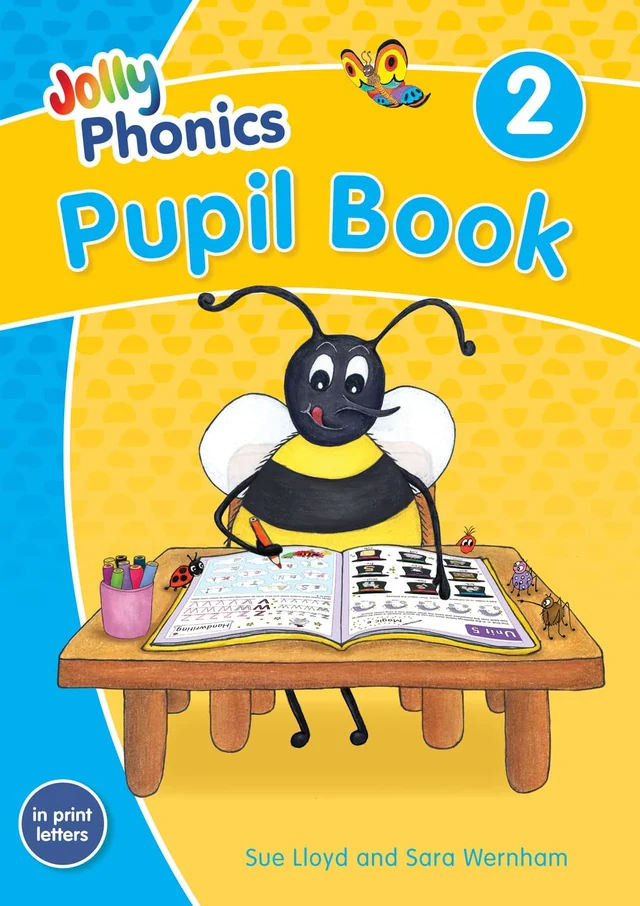
| Authors | Sara Wernham and Sue Lloyd |
|---|---|
| Publisher | Jolly Learning |
| Role | The second write-in book for the child |
| Four main topics | Alternatives, Handwriting, Tricky Words, Words and Sentences |
| Edition | Colour, British English; refreshed edition with the same core content |
| ISBN | 978-1-84414-720-5 (print letters). A precursive edition is also published |
| Comes after | Pupil Book 1 |
| Comes before | Pupil Book 3 |
| Lesson plans in | Teacher’s Book |
We have not given a page count here because the sources we checked did not state one. Check the listing for the edition you are buying.
What Is Jolly Phonics Pupil Book 2?
Jolly Phonics Pupil Book 2 builds on Pupil Book 1 by teaching the main alternative vowel spellings. It also covers capital letters and the alphabet, more tricky words and guided writing activities. The publisher groups its content into four topics: Alternatives, Handwriting, Tricky Words, and Words and Sentences.
Book 1 gives a child one spelling for each sound. Book 2 shows that the same sound can be spelled in more than one way, and begins to write words and sentences with more help from the adult.
Who It Is For and When to Start
- Children who have worked through Pupil Book 1 and can blend simple words.
- Children who read words like rain but write plai for play: they know one spelling and need the others.
- Children who need to learn capital letters and the alphabet properly.
If a child has not yet secured the 42 sounds and blending, go back to Book 1 first. Starting Book 2 too early usually causes confusion.
Syllabus: The Four Topics
| Topic | What the publisher says it covers | What it means for the child |
|---|---|---|
| Alternatives | The main alternative vowel spellings | Learns that one sound can be written in different ways |
| Handwriting | Capital letters and the alphabet | Writes capitals and knows the alphabet in order |
| Tricky Words | More tricky words | Reads and spells more common words that do not follow the usual sound pattern |
| Words and Sentences | Guided writing activities | Moves from single words to short written pieces with help |
The exact order of pages is in the book and the Teacher’s Book lesson plans. The publisher says the activities also keep practising letter formation, hearing sounds in words and blending.
Alternative Vowel Spellings Explained
Alternative spellings are different ways of writing the same sound. These are examples of the main vowel families taught in Jolly Phonics. Your copy of Book 2 shows the exact selection and order.
| Sound | First spelling | Alternatives | Examples |
|---|---|---|---|
| /ai/ | ai | ay, a-e | rain · play · cake |
| /ee/ | ee | ea, e-e, y | feet · sea · these · happy |
| /ie/ | ie | igh, y, i-e | tie · night · fly · time |
| /oa/ | oa | ow, o-e | boat · snow · home |
| /ue/ | ue | ew, u-e | cue · new · tune |
| /oi/ and /ou/ | oi, ou | oy, ow | coin · boy · out · cow |
This is the idea behind the book, not a copy of it. Our guide to Jolly Phonics alternative spellings explains when alternatives are taught, patterns that help children choose and the “try both” strategy.
Handwriting: Capital Letters and the Alphabet
Book 1 focuses on lower-case letters. Book 2 adds capital letters and the alphabet. This is where a child learns that the same letter has two forms, and that the alphabet has an order separate from the sounds.
- Teach capitals for names first: the child’s own name, then family names.
- Keep letter style the same as school: print or precursive.
- Say the letter name and the sound together: “capital A says /a/”.
- Practise alphabet order with a song or a chart, not only on the page.
See letter formation for the formation steps.
Tricky Words in Pupil Book 2
Pupil Book 2 adds more tricky words to the first set from Book 1. Children now meet common words such as was and said that contain a spelling they cannot yet sound out in the usual way. The routine is the same as in Book 1: blend the sounds, spot the tricky part, say it, write it.
Our tricky words guide shows the whole list by level.
Words and Sentences: Guided Writing
The Words and Sentences topic moves from spelling a word to writing something with it. At this stage the adult helps: the child says the sentence aloud, counts the words, stretches each word into sounds, and writes them.
- Say the whole sentence aloud.
- Hold the sentence in mind while writing each word.
- Stretch each word into its sounds (segmenting) and write the letters.
- Leave a space between words.
- Read the sentence back and check it makes sense.
See segmenting in phonics for the spelling skill.
Skills It Builds and How It Benefits Your Child
| Skill | What you may see | How to support it |
|---|---|---|
| Spelling choice | The child tries more than one spelling and picks the right one | Use the “try both” strategy and read the word back |
| Reading more complex words | Words with alternative spellings are read more smoothly | Sort word cards by spelling pattern |
| Writing capitals correctly | Names and sentence starts use capitals | Check names first |
| Alphabet knowledge | The child can say the alphabet in order | Sing it and use a chart |
| Early sentence writing | The child writes a short sentence with help | Say, count, stretch, write, read back |
How to Use Pupil Book 2, Step by Step
- Read the matching lesson in the Teacher’s Book.
- Revise the Book 1 sounds quickly, then introduce one alternative family.
- Read words with the new spelling aloud together.
- Let the child do the Pupil Book page, then check it with the answer key.
- Add a short dictation of two or three words.
- Re-read the page at the next session before moving on.
Common Mistakes
- Introducing several alternatives for the same sound on the same day.
- Treating alternative spellings as rules to memorise, instead of patterns to try.
- Starting Book 2 before blending is secure.
- Skipping handwriting because the child can already write.
- Marking only spelling and not reading back for meaning.
Is Your Child Ready for Pupil Book 3?
A child is usually ready for Pupil Book 3 when they can read most Book 2 words without sounding them out, write capital letters and the main alternative spellings with help, and write a short sentence with guidance. If not, spend more time on Book 2 pages and sentence work first.
Related Reading
See also the overview of all four books.
Independent study guide. Jolly Phonics books are written by Sue Lloyd and Sara Wernham and published by Jolly Learning. Jolly Reading is an independent teaching and training provider. We do not publish or sell these books, and this page is not an official publisher page. Book details come from the publisher’s catalogue and product listings; check your own copy for the exact edition, page layout and price.
Where the book details come from. Jolly Learning catalogue (2024), Jolly Learning product listings for the Pupil Book 2, and the publisher’s sample lesson for the sound /r/. Teaching advice on this page is ours and is written for study purposes, not as a reproduction of the book.
Frequently Asked Questions
What does Jolly Phonics Pupil Book 2 cover? +
It covers the main alternative vowel spellings, capital letters and the alphabet, more tricky words and guided writing activities. The publisher groups it into Alternatives, Handwriting, Tricky Words, and Words and Sentences.
Do you need Pupil Book 1 before Pupil Book 2? +
Yes, the books are meant to be used in order. Book 2 builds on the reading and writing skills taught in Book 1.
What are alternative spellings in Jolly Phonics? +
They are other ways of writing a sound that has already been taught. For example, /ai/ is first taught as ai, and later as ay and a-e.
Does Pupil Book 2 teach all 42 sounds? +
No. The 42 main sounds are taught in Pupil Book 1. Book 2 assumes the child already knows them and builds on that knowledge.
Can a child use Pupil Book 2 without the Teacher’s Book? +
It is possible, but the lesson plans and answer keys are in the Teacher’s Book. We recommend using both.
What is the ISBN of Jolly Phonics Pupil Book 2? +
978-1-84414-720-5 is the ISBN of the print-letters edition. A precursive edition has a different ISBN, so check the listing.
What comes after Pupil Book 2? +
Pupil Book 3, which consolidates the skills from Books 1 and 2 with new spellings, new tricky words, words and sentences and reading comprehension.