Why Guessing Words Is a Hidden Reading Problem
What does “guessing words” mean in reading?
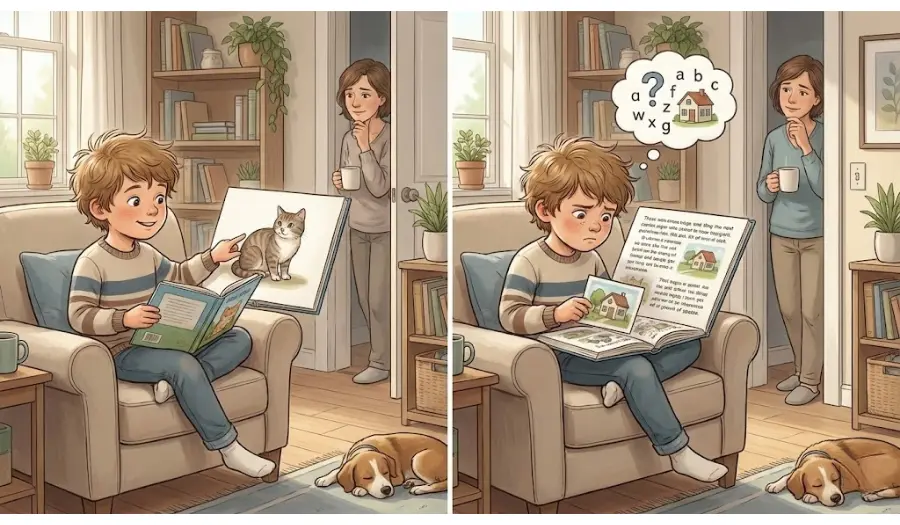
Guessing words happens when a child reads by using pictures, memory, or context instead of sounding out the word using phonics.
However, guessing often looks like real reading at first. As a result, the problem stays hidden for a long time.
This page explains why guessing words is dangerous, how parents can spot it early, and what they can do to fix it correctly.
Table of Contents
Why is guessing words considered a problem?
What does “guessing words” mean in reading?
Guessing words prevents children from learning how reading actually works.
Reading is a skill based on decoding sounds, not predicting words.
Therefore, when children guess words:
- They avoid sounding out words
- They rely on memory instead of phonics
- They struggle as reading material becomes harder
Because of this, early “success” often turns into later reading difficulty.
Why do children start guessing words?

Children do not guess because they are lazy. Instead, guessing is usually a coping strategy.
Common reasons children guess words include:
- Weak phonological awareness
- Incomplete phonics instruction
- Being pushed to read too early
- Learning sight words before decoding
- Over-reliance on pictures
As a result, guessing becomes a habit rather than a reading skill.
👉 Read more → Phonological Awareness Explained for Parents
How guessing looks different from real reading

At first, guessing words can look impressive.
However, there are clear warning signs.
Signs your child may be guessing words:
- Looks at pictures before reading
- Says a word that fits the story but is incorrect
- Skips small words
- Changes words without noticing
- Struggles with new or unfamiliar words
Moreover, the child often reads smoothly only with familiar books.
Why guessing often goes unnoticed by adults
Guessing is a silent problem.
Teachers and parents may think:
- “My child reads fast”
- “They know many words”
- “They are doing fine”
However, speed without decoding is risky.
As a result, the problem usually appears later, not immediately.
What happens when reading becomes harder?
As books become longer:
- Pictures reduce
- Vocabulary increases
- Sentence structure becomes complex
Therefore, guessing stops working.
Children who relied on guessing may:
- Avoid reading
- Lose confidence
- Struggle with comprehension
- Fall behind peers
 Read more → Is My Child Behind in Reading?
How guessing affects spelling and writing
Guessing words does not only affect reading.
It also impacts spelling.
Children who guess:
Memorise word shapes
Cannot break words into sounds
Spell inconsistently
As a result, spelling becomes stressful and confusing.
👉 Read more → Blending & Segmenting Made Simple for Parents
Why memorising sight words can increase guessing
Sight words are often misunderstood.
When children memorise words before learning phonics:
- They store words visually
- They skip decoding
- They guess unfamiliar words
For this reason, sight words should be introduced later, alongside phonics, not instead of it.
How phonics stops guessing naturally
Phonics teaches children how reading actually works.
Children learn that letters represent sounds and sounds combine to form words. Because of this, guessing gradually disappears.
Over time, reading becomes logical. As a result, confidence grows naturally.
👉 Read more → Phonics Rules by Age
What parents can do if their child is guessing words
First, stay calm. Guessing words is common, especially in early readers.
Helpful steps parents can take:
- Encourage the child to sound out words
- Cover pictures during reading
- Slow down reading speed
- Use decodable books
- Praise effort, not speed
Moreover, consistency matters more than correction.
What parents should avoid doing
To prevent confusion, parents should avoid:
- Asking children to “read faster”
- Prompting with the first letter
- Letting pictures do the reading work
- Correcting without guidance
Instead, guide gently and patiently.
When guessing words is most likely to appear
Guessing often appears:
- Around ages 5–7
- When phonics steps are skipped
- During early school reading
Therefore, early detection makes correction easier.
How guessing can be corrected successfully
The good news is that guessing can be fixed.
With structured phonics instruction, children relearn decoding. Reading may slow down at first.
However, accuracy improves steadily. As a result, confidence returns.
How this fits into the full reading journey
Guessing words appears when reading foundations are weak.
The correct reading sequence is:
- Phonological awareness
- Letter sounds
- Blending for reading
- Segmenting for spelling
- Advanced phonics
Skipping steps often leads to guessing habits.
👉 Read more → Phonics Rules by Age
Final reassurance for parents
Guessing words does not mean failure.
It simply means your child needs clearer instruction, not more pressure.
When decoding is taught correctly:
- Guessing fades
- Reading becomes easier
- Learning feels safe again
Final reassurance for parents
Structured phonics teaches children how to decode words using sounds, rather than memorising or guessing. Lessons follow a clear sequence, helping children understand how reading actually works. This approach builds accuracy, confidence, and long-term reading success.
Phonics is especially helpful for children who guess words, avoid reading, or spell inconsistently. By strengthening sound–letter connections, children learn to read and spell more confidently.
Most children are ready to begin phonics around age 4, once they can listen to sounds and follow simple instructions. Advanced phonics is suitable when children already know basic letter sounds and are ready to read longer words.
Basic phonics focuses on letter sounds, blending, and simple words.
Advanced phonics builds on this by teaching long vowels, digraphs, blends, syllables, spelling rules, and reading fluency.
Guessing is a common hidden problem. Phonics helps children slow down, decode words accurately, and rely less on memory or pictures. This improves both reading accuracy and confidence.
Absolutely. Phonics teaches children how to break words into sounds for spelling. This makes writing easier and reduces frustration caused by inconsistent spelling.
Every child progresses at a different pace. However, with regular practice and structured lessons, many parents notice better decoding, improved confidence, and fewer guessing habits within a few weeks.
Yes, but they should be introduced carefully. Sight words work best after phonics foundations are in place and should support decoding, not replace it.
Yes, when lessons are interactive and guided. With clear instruction, actions, sound practice, and regular feedback, children can learn phonics effectively in an online setting.
If your child struggles with blending, spelling, fluency, or guesses words while reading, phonics support can help. A simple assessment usually clarifies whether basic or advanced phonics is the right starting point. You can Book Demo Classes
Phonics Support That Builds Confidence
Is Your Child Guessing Words or Avoiding Reading?
If your child:
Guesses instead of sounding out
Reads but lacks confidence
Struggles with spelling
Finds reading tiring


Megha Vyas
Founder of Jolly Reading with 23+ years of phonics teaching experience. Certified in Jolly Phonics and Jolly Grammar from Jolly Phonics CPD College, UK. Former Air India Air Hostess with expertise in phonetics, spoken English, and remedial education.